
Choosing between monolithic and microservices architecture affects how you develop, deploy, scale, and maintain applications. Both approaches support enterprise applications, but they differ in how they organize and manage software components.
Monolithic architecture combines application functionality into a single deployable unit, while microservices architecture divides it into independently deployable services that communicate through APIs or messaging systems.
Understanding the differences between monolithic vs microservices architecture helps organizations select an approach based on application complexity, scalability, development requirements, and long-term business goals.
What Is Monolithic Architecture?
Monolithic architecture is a software design approach in which an application’s core components run as a single deployable unit.
For example, an e-commerce application might manage customer accounts, product catalogs, orders, payments, and inventory within one application. These components typically share a common codebase and often use a centralized database.
Because the components work together, development, testing, and deployment can be relatively straightforward, especially for smaller applications.
Advantages of Monolithic Architecture
- Simpler development: Teams can develop and test functionality within a single application.
- Straightforward deployment: The application is packaged and deployed as one unit.
- Easier debugging: In-process communication simplifies tracing application errors.
- Lower operational complexity: Fewer distributed components reduce infrastructure management requirements.
Limitations of Monolithic Architecture
As applications grow, dependencies between components can make maintenance more difficult. Even minor changes may require rebuilding and redeploying the entire application.
Scaling can also become inefficient when only specific functions require additional resources. However, a well-structured modular monolith can address many maintainability challenges without introducing distributed services.
What Is Microservices Architecture?
Microservices architecture divides an application into smaller services, each responsible for a specific business capability.
For example, an e-commerce platform may use separate services for authentication, inventory, payments, and order management. These services communicate through APIs or asynchronous messaging.
Each service can be developed, deployed, and scaled independently, allowing engineering teams to manage different application capabilities.
Advantages of Microservices Architecture
- Independent scaling: Individual services can scale according to workload.
- Deployment flexibility: Teams can release services independently.
- Team autonomy: Engineering teams can own specific business capabilities.
- Technology flexibility: Services can use different technologies when justified.
- Fault isolation: Properly designed services can limit the impact of individual failures.
Limitations of Microservices Architecture
Microservices introduce distributed-system complexity. Communication between services involves network latency, potential failures, and additional security requirements.
Managing data consistency, service dependencies, monitoring, and deployment automation also requires engineering expertise and supporting infrastructure.
Consequently, microservices are not automatically more efficient or cost-effective than monolithic applications.
Monolithic vs Microservices Architecture: Key Differences
The primary difference between monolithic and microservices architecture lies in how application functionality is organized, deployed, and scaled.

| Factor | Monolithic Architecture | Microservices Architecture |
| Structure | Single deployable application | Independent services |
| Deployment | Components deployed together | Services deployed independently |
| Scalability | Typically scales the whole application | Services scale individually |
| Database | Often uses a shared database | Typically follows service-owned data boundaries |
| Communication | Primarily in-process calls | APIs or asynchronous messaging |
| Fault isolation | Failures may affect the application | Failures can be isolated with resilience mechanisms |
| Testing | Simpler centralized integration testing | Requires distributed integration and contract testing |
| Infrastructure | Lower operational complexity | Requires distributed monitoring and management |
| Team structure | Suitable for smaller, centralized teams | Supports independently managed service teams |
Scalability and Performance
Monolithic applications commonly scale by increasing resources or replicating the entire application. Microservices allow resource-intensive components to scale independently.
However, communication between services introduces network overhead. Actual performance depends on application design, infrastructure, and workload characteristics.
Deployment and Maintenance
Monolithic applications generally require redeploying the complete application when changes are released.
Microservices support independent deployments, but require reliable CI/CD pipelines, API compatibility, and coordinated monitoring to maintain stability.
Data Management
Monolithic applications often use shared databases, simplifying transactions across modules.
Microservices typically establish separate data ownership boundaries, which can improve independence but complicate cross-service transactions and consistency.
Organizations may require event-driven communication, eventual consistency, or distributed transaction patterns to manage these dependencies.
When Should You Choose Monolithic or Microservices Architecture?
Selecting the right architecture depends on business requirements, application complexity, engineering capabilities, and operational readiness.
Choose Monolithic Architecture When:
- Developing a relatively small application or early-stage product.
- Working with a small engineering team.
- Managing closely connected business functions.
- Prioritizing development simplicity and predictable deployment.
- Independent scaling is not a significant requirement.
A modular monolith can also clearly separate business components while keeping a single deployment unit.
Choose Microservices Architecture When:
- Different application components have distinct scaling requirements.
- Multiple teams need independent development and release cycles.
- Business domains have clearly defined boundaries.
- Frequent deployments are necessary.
- The organization has mature DevOps and monitoring capabilities.
For example, a large retail platform may benefit from independently scaling its inventory and search services during periods of increased demand.
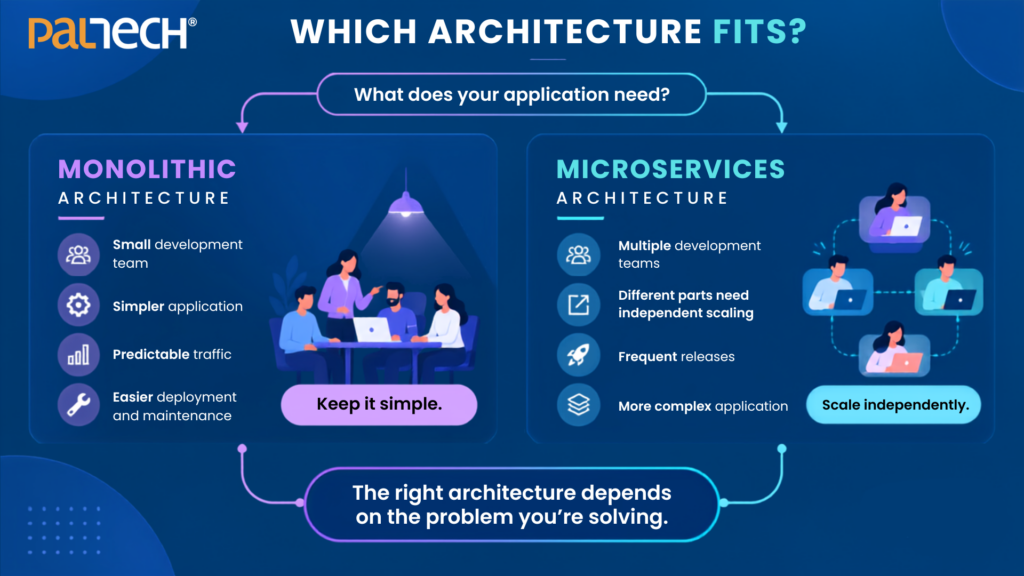
However, application size alone does not justify microservices. Poor service boundaries can create unnecessary dependencies and operational challenges.
Key Challenges in Migrating from Monolithic to Microservices
Moving from a monolith to microservices requires careful planning beyond simply splitting the application code.
- Identifying Service Boundaries
Determining which functionality belongs in each service is critical. Poorly defined boundaries can increase dependencies and communication overhead.
Domain-driven design can help identify business capabilities and establish appropriate service boundaries.
- Managing Data Dependencies
Monolithic applications often share databases across multiple components. Extracting services requires defining data ownership and addressing cross-service transactions.
Without proper planning, services may remain tightly coupled through shared data.
- Managing Distributed Communication
Replacing internal function calls with network communication introduces latency, timeouts, and potential service failures.
Mechanisms such as retries, circuit breakers, and asynchronous messaging help manage these risks.
- Increasing Operational Readiness
Microservices require centralized logging, distributed tracing, automated deployments, and service-level security controls.
Organizations must establish these capabilities to maintain reliability across distributed environments.
How to Migrate from Monolithic to Microservices Architecture
A complete rewrite is not always necessary. Organizations can gradually extract functionality while keeping the existing application operational.
The Strangler Fig pattern supports this incremental modernization approach.
A practical migration process includes:
Step 1: Assess the existing architecture
Identify performance bottlenecks, application dependencies, deployment limitations, and maintenance challenges.
Step 2: Define service boundaries
Select components with clear business responsibilities and manageable dependencies.
Step 3: Establish communication and data ownership
Define APIs, security requirements, and data integration mechanisms between existing and new components.
Step 4: Migrate incrementally
Extract selected functionality into services while maintaining compatibility with the existing application.
Step 5: Monitor and optimize
Evaluate reliability, performance, deployment efficiency, and operational costs before expanding the migration.
An incremental strategy reduces migration risks while allowing organizations to evaluate whether microservices deliver measurable benefits.
Conclusion
The choice between monolithic and microservices architecture depends on application requirements, scalability needs, engineering resources, and operational complexity.
Monolithic architecture provides development simplicity and centralized management, while microservices offer independent deployment and scaling flexibility at the cost of greater distributed-system complexity.
For organizations modernizing existing applications, improving modularity or gradually extracting services may be more effective than replacing the entire architecture.
PalTech’s Digital Product Engineering and Application Modernization capabilities help organizations evaluate architecture requirements, address technical limitations, and develop modernization strategies aligned with business objectives.
Explore how PalTech can support your application modernization journey.
Frequently Asked Questions
What is the main difference between monolithic and microservices architecture?
Monolithic architecture combines application functionality into a single deployable unit. Microservices architecture separates functionality into independently deployable services that communicate through APIs or messaging. The main differences involve deployment, scaling, communication, and operational management.
Is microservices architecture better than monolithic architecture?
Not necessarily. Microservices support independent scaling and deployment but introduce distributed-system complexity. Monolithic architecture may suit smaller applications, closely connected business functions, and teams that prioritize operational simplicity.
When should an application migrate from monolithic to microservices?
Migration may be appropriate when the existing architecture makes independent scaling, frequent deployments, or team coordination difficult. Organizations should first evaluate whether improving the existing monolith can address these challenges.
Are microservices more expensive than monolithic applications?
Microservices can cost more in infrastructure and operations because they require additional monitoring, deployment automation, and service communication. However, independent scaling may improve resource efficiency for suitable workloads.
Can a monolithic application be modernized without a complete rewrite?
Yes. Organizations can improve modularity, upgrade application frameworks, optimize databases, and incrementally extract selected functionality into services. The Strangler Fig pattern commonly supports gradual modernization.
What is a modular monolith?
A modular monolith organizes application functionality into well-defined modules while keeping it as a single deployment unit. It provides clearer separation of responsibilities without requiring independently deployed services.